Mark 4:35-41
Saturday of the Eleventh Week in Ordinary Time
Mt 6:24-34
Jesus said to his disciples:
“No one can serve two masters.
He will either hate one and love the other,
or be devoted to one and despise the other.
You cannot serve God and mammon.
“Therefore I tell you, do not worry about your life,
what you will eat or drink,
or about your body, what you will wear.
Is not life more than food and the body more than clothing?
Look at the birds in the sky;
they do not sow or reap, they gather nothing into barns,
yet your heavenly Father feeds them.
Are not you more important than they?
Can any of you by worrying add a single moment to your life-span?
Why are you anxious about clothes?
Learn from the way the wild flowers grow.
They do not work or spin.
But I tell you that not even Solomon in all his splendor
was clothed like one of them.
If God so clothes the grass of the field,
which grows today and is thrown into the oven tomorrow,
will he not much more provide for you, O you of little faith?
So do not worry and say, ‘What are we to eat?’
or ‘What are we to drink?’ or ‘What are we to wear?’
All these things the pagans seek.
Your heavenly Father knows that you need them all.
But seek first the Kingdom of God and his righteousness,
and all these things will be given you besides.
Do not worry about tomorrow; tomorrow will take care of itself.
Sufficient for a day is its own evil.”
Jan Brueghel (Meseo Nacional Thyssen-Bornemisza, Madrid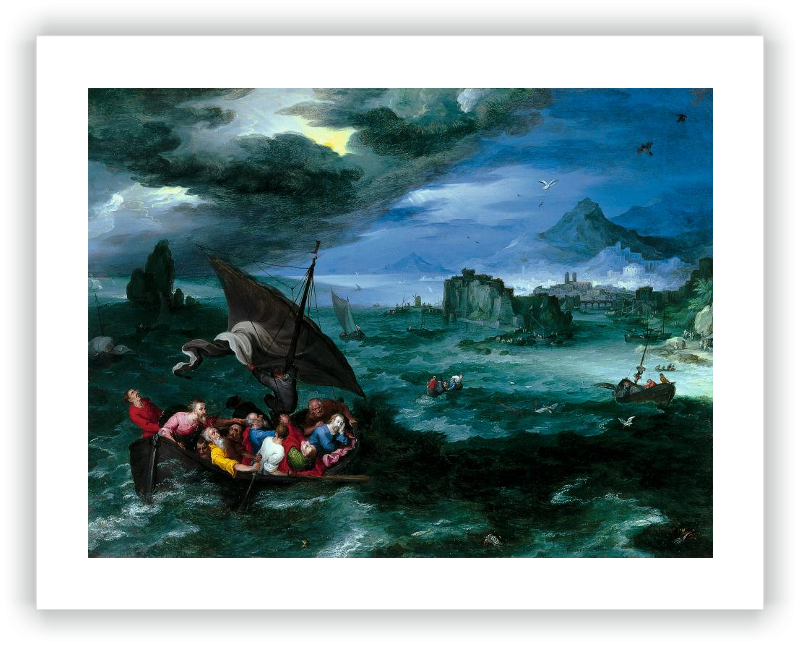
In Mark 4, the disciples
“were filled with awe” after
Jesus stills the storm. While
the waves were crashing
over their boat, their Lord
and master slept in the
stern. This is an evocative moment, echoing both Jonah
(who also slept in a boat during a storm) and the God
who neither slumbers nor sleeps (Psalm 121:4). When
the disciples wake Jesus, their cry is a prayer to a God
who appears to be asleep in a storm: “Do you not care
we are perishing?” Jesus commands the sea to be
still and then turns from rebuking the waves to gently
rebuking his disciples’ lack of faith. He does not reveal
his confidence that they will grow in faith. The disciples
cannot yet answer the question, “Who is this then?”
Courage doesn’t mean “absence of fear.” In fact, the
most courageous people are doing brave things in spite
of their fear. Even in our moments of great peril or agony,
recall the God who commands even the wind and sea
with authority. If this is who walks with us, how can we
build our faith that we will make it through the storm?
Source: The Almanac for Pastoral Liturgy 2024


 Thumb & Four Fingers